All weightlifters snatch, clean, jerk, squat, pull, and press to some degree or another. The coach and the training environment are the only proprietary ingredients to a training system. This is why I publish my team’s program online. The magic happens at practice because I can dictate individual exercise changes and weight selection based off what I see. I have my own training principles that I use to guide my lifters along during practice, as does every other coach out there.
Some of the principles I use that guide me along when writing my team’s training cycles:
- Prioritize the classic lifts (snatch, clean, jerks) and their variations (powers, hangs, blocks, complexes, etcetera); this is the backbone of the training plan no matter what.
- Many start this sport as adults and therefore do not have the years of repetition and practice under their belt that their competitors do
- Practicing the jerk is a priority (third attempt jerks are rarely made in competition).
- Always jerk after a clean
- Train jerks while fatigued (especially after squats)
- Training in the lower percentages (≤75%) is just as important as higher percentages. This conditions the body for heavier weights and is light enough to practice.
- Squats, pulls, and presses are necessary but should be treated as an afterthought. Some periods of training volume in these exercises may increase but should not approach the same volume as snatch, clean, or jerk.
- Chasing specific numbers in these exercises at the expense of practicing the classic lifts hinders overall progress (in my experience)
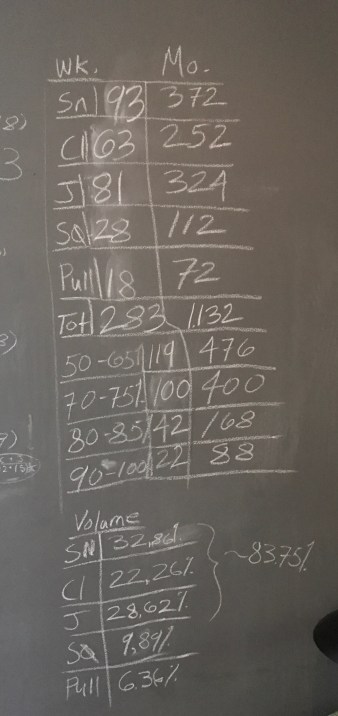
This does not mean the program and the training cycle are irrelevant. Laying out the numbers and exercises for a training phase gives me an objective look at the year so I can see the total number of lifts and the intensity breakdown to see how my lifters react to the volume and the intensity. I can ask myself if this appropriate training for where we are now and where we want to go. When reevaluating a training phase I can compare and contrast it to other more or less successful ones from the past.
The template is useful for my lifters as well because they can see the variations of intensity throughout the week, and they understand that light days are in place prior to a heavy day of practice. My lifters can look at two weeks of training and see they need to prioritize their recovery based on the volume/intensity distribution.
 Manhattan Barbell